
What is Boneyards of Steel about?
by Lorraine Evans - 09:22 on 12 August 2026

The study of aviation graveyards is a much-maligned area of death research. The final resting place of sizeable non-organic flying beasts is routinely overlooked, yet it is still, in every respect, a graveyard and deserves to be recognized as such. From an extensive desert necropolis to a war-torn underwater mausoleum, very little of the world remains untouched by aviation graveyards; in fact, one could argue that the entire planet is just one huge aviation graveyard, and less has been written about these remarkable sites. With a significant percentage still languishing in ‘Top-Secret’ military facilities, hidden behind barbed wire-fences and gated perimeters, it is hardly surprising. Nonetheless, advancements in technology have enabled those with an adventurous spirit, armchair or otherwise, to peel back these layers of secrecy and take a sneaky peak at the skeletal remains of once aeronautic marvels, the findings of which are astonishing, and often bizarre.
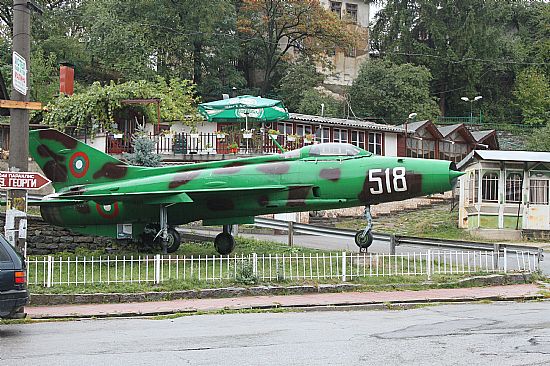
The meanings attached to death vary from one society to another, as does the disposal of the dead, which tells us much about how people perceive themselves and the world around them. It is no different for dead aircraft. For instance, here in the United Kingdom, when decommissioned aircraft reach the ‘end of the road’, they are, more often than not, thrown onto a trash heap, awaiting the inevitable visit from an aviation death-dealer (i.e. scrap merchant). Whereas in the bygone Soviet Union, and associative Eastern Bloc countries, instead entire fighter jets, specifically the MiG variant, were often utilized as individual commemorative headstones—yes, entire aircraft—for former fighter pilots. Many of these independent MiG fighter jets can still be found proudly cemented to a sturdy pole, in some out-of-the way village square.
I took the decision, quite early on, to move away from the more traditional aviation crash site approach, especially regarding those aircraft that had been shot down and/or crashed during the Second World War. In truth, there are many excellent books out there on this specific topic, see Select Bibliography, often written by those who were there at the time, digging out the remains, documenting the histories etc., so I do not feel it would be to anyone’s benefit if I simply rehash what has already been told. It should be said though that anyone attempting to research the subject today, at a high level, will soon face streams of inconsistencies in descriptions of the same events in different books. One of the more interesting aspects of graveyard hunting is trawling for clues in the National Archives, in Kew, Surrey. Boneyards of Steel was no exception. However, during the research process it quickly became apparent that the task at hand was immense; for example, there are literally tens of thousands of Second World War Operational Record Book entries to decipher, hampered in no part by yours truly veering off on some tangent when something exciting caught her eye. If I had a pound for every time I exclaimed ‘Oooooo a Dakota in Mogadishu!’ I’d be a very rich woman indeed. Furthermore, the research process was not helped by the RAF abandoning the process of documenting an aircraft’s serial number and/or engine number on its official RAF record card as the war continued. Consequently, looking for information linking lost airfields with aircraft burial pits at the end of the Second World War has become a separate project, one of which I hope to join forces with other aviation devotees in the not-too-distant future. If anyone reading this would be interested in participating, or has any information regarding aviation burial pits, not mentioned in chapter 3, please do feel free to make contact. I would be delighted to hear from you.
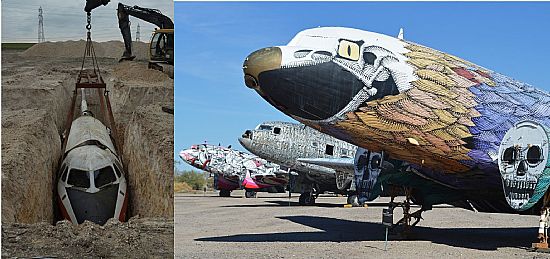
By choice, I have chosen to focus on the mortuary aspect of aircraft death, to explore those areas which may not be immediately apparent to the reader. By utilizing said framework, I was able to uncover some rather compelling archetypes, such as entire fighters jets buried under the desert sands of Iraq; an underwater spacecraft cemetery located in the middle of nowhere; aeroplane burial sites in Belize, South America, belonging to drug cartels; and a Coach fashion boutique sited in the interior of a decommissioned Boeing 747 passenger aircraft. That is not to say that the subject of crash sites is not discussed. Chapter 5, ‘Lest We Forget’, paints a picture of the distinct variations found within this category.
Postscript - Unbeknownst to me, only two months after I completed Boneyards of Steel, and submitted the manuscript to my publisher, I would acquire/take the helm of a once active, but defunct aviation archaeology group, namely A.R.G.O.S. (Aviation Research Group Orkney & Shetland). Since then, my life has become a whirlwind of aviation gravesites, and in only a few short months we have successfully identfied the specification of a possible Spitfire wreck, completed the Knowing what I know now, in only a few short months, and I am currently liaising with the Ministry of Defence in regards to an undocumented Seafire crash. I am sure you can appreciate that knowing what I know now, Boneyards of Steel may have taken a slightly different path. A.R.G.O.S. is now very much active, both on land and at sea, the aims of which are to re-assess old data and utilize new technology in identifying potential aviation gravesites, implementing the highest professional archaeological standards throughout. A dive team is being assembled and targets are being identified for 2026/27. Reports/findings will be open sourced, either via the A.R.G.O.S. website or other internet platforms.
Let the adventures commence!
Add your comment