
Amari Pilot's Graveyard - Estonia
by Lorraine Evans - 10:57 on 20 August 2026
Across the world there exists a vast network of remembrance landscapes, in the form of gravesites, funerary architecture, memorial gardens, constructed cairns and so forth, that commemorate some kind of aviation mishap, whether that be down to mechanical failure, combat, adverse weather conditions or even terrorist activity. Touching both military and civilian aircraft alike, some are simple affairs, maybe a small, decorated stone honouring the fallen, a wooden cross or a simple plaque, whereas others are rather more grandiose constructs. Many aircraft, though, still lie where they fell, their metallic body and internal organs strewn across some inhospitable, barren terrain.
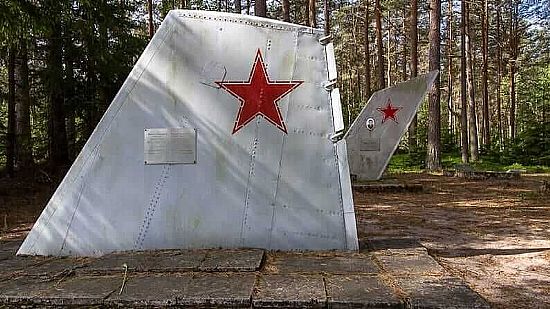
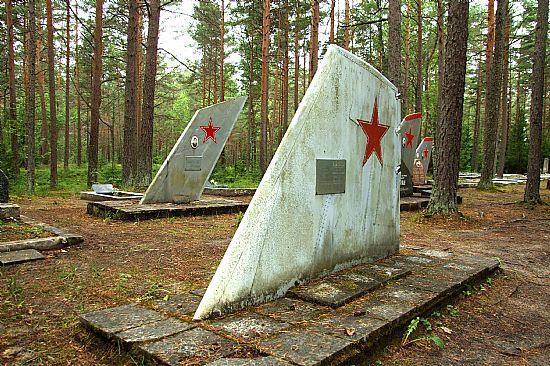
In a secluded stretch of woodland, adjacent to Estonia's Ämari Air Base, lies an old Soviet pilot’s graveyard, and visually one of my all-time favourite aviation graveyard sites. From the time of its conception during the Second World War, up until the breakup of the USSR, the airfield was under the control of the Soviet Union, the base known as the Suurküla aerodrome. Today, it hosts the NATO-backed Baltic air-policing mission, an air defence system put in place to safeguard the airspace over the three Baltic states of Estonia, Lithuania and Latvia. The pilot's graveyard is small in design and was purposely sited a short distance away from the airbase, during the Soviet era, so as to not deflate the morale of the airmen stationed there, according to sources. Built over the site of a former war cemetery, it primarily consists of several crude grave markers dotted haphazardly throughout the trees. There are some markers, however, that are unique, even by Soviet standards, and comprise original aircraft tail fin tombstones, seconded from a variety of Russian aircraft.
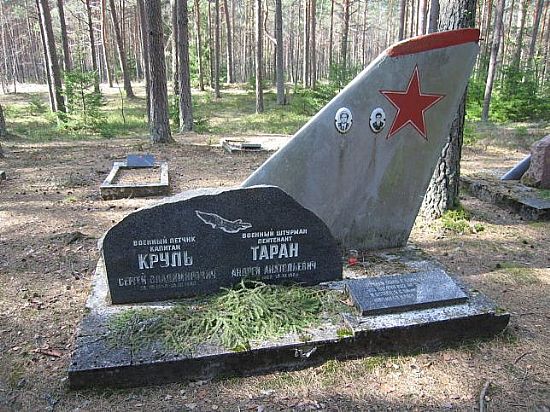
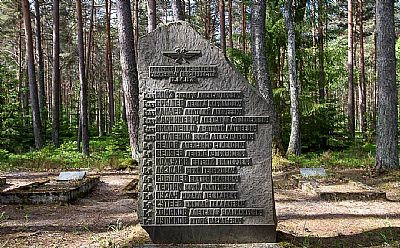
Opinion differs regarding the tail fin markers. Whether they originate from the specific aircraft involved in the accidents that killed the aviators is unknown. Some historians are adamant they do, but there is no recorded evidence that any of these pilots buried within died whilst in combat. Most fatalities occurred as a result of accidents and instrument failure during training exercises and/or reconnaissance missions, usually involving the Russian-designed Sukhoi Su-24, a supersonic medium-range bomber that is still in use today. In fact, the most devastating recorded accident happened on the ground and not in the air when, in April 1978, an aircraft overshot its taxi-stand and hit a stationary truck, bursting into flames, killing a total of sixteen men. Their names can be seen carved upon a singular commemorative stone within the cemetery confines. Along the same line, there is also no evidence to suggest that every aircraft tail represents the physical burial of a dead pilot, as Estonian sources suggest that it was the norm to return the remains of any deceased back to their homeland for burial. That is not to say a few dead Soviet servicemen are interred underneath these remarkable tombstones, but in all probability, they are just memorials, erected in the graveyard to honour their memory.
Further details regarding aviation grave markers can be found in Boneyards of Steel - Exploring the World's Aircraft Graveyards. (Images: Katmandhu&Beyond)
Add your comment